
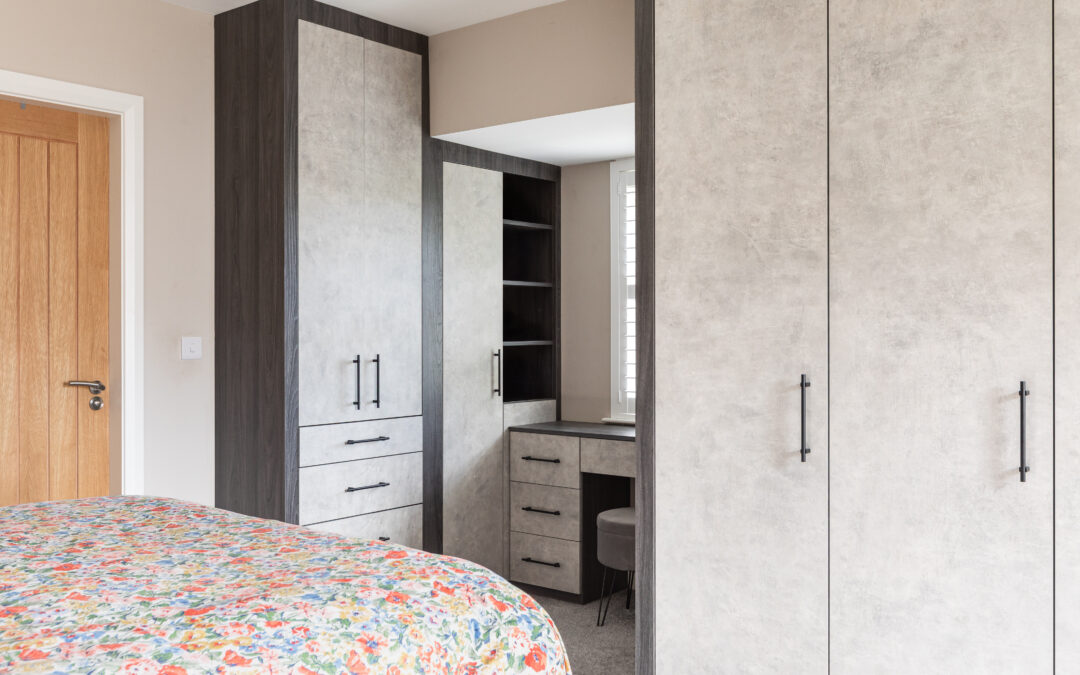
Made-to-measure furniture costs more to buy than mass-produced furniture, but it’s often the better-value choice over the years you own it. It lasts longer, uses all the space you’ve paid for, replaces several standalone pieces, and can be refreshed rather than replaced when its style starts to date. The exception is if you’re only staying put for a short time, in which case something you can take with you may make more sense.
We’ve designed, made and fitted furniture for homes across Northern Ireland since 1992, and the conversation about price comes up at most design appointments. This guide sets out how we’d approach the figures if it were our own home. If you’re still getting to grips with what bespoke furniture actually means, that’s a good place to start.
Upfront Price vs Real Cost
The price on a quote tells you what you’ll pay on the day. It doesn’t tell you what the furniture will cost you over the years you live with it. That’s the figure worth comparing.
| Cost over the life of the furniture | Mass-produced furniture | Made-to-measure furniture |
| Purchase price | Lower | Higher |
| Assembly and fitting | Your time, or an extra fee | Professionally installed (at Enhance, by our own fitting team) |
| How long it lasts | Often replaced when it wears, breaks or doesn’t survive a move | Built for decades of daily use |
| Space it uses | Standard sizes, often leaving gaps above and beside | Floor to ceiling and wall to wall |
| Extra furniture needed | Chests of drawers, shoe racks and storage boxes to make up the shortfall | Drawers, shoe storage and shelving built into the interior |
| When the style dates | Replace the whole piece | Replace the doors, keep the interior |
Work It Out Per Year
A simple way to compare two options is to divide the price by the number of years you expect to use it. A wardrobe that costs twice as much but lasts three times as long costs less per year you own it. That’s before you count the furniture it saves you from buying, or the cost and hassle of replacing a lower-priced one along the way.
It’s not a perfect science, since nobody knows exactly how long anything will last. But it shifts the question from “which costs less today?” to “which costs less over the time we’ll be living here?” That’s the question that matters if you’re settled in your home.
You’re Already Paying for the Space
You pay for every square metre of your home, whether through your mortgage or rent, so storage that leaves space empty is costing you more than its price tag suggests.
Height is the easiest place to see this. Many UK homes have ceilings of around 2.4m, while a standard wardrobe is typically around 2.1m tall. That leaves roughly 30cm of empty space running along the full width of the wardrobe. On a three-metre run, that’s a long strip of usable storage that ends up holding dust or a row of boxes. The gaps at each side and the alcove that’s slightly too narrow for the next size down add up in the same way. Made-to-measure furniture is built to the room’s actual dimensions, so that space becomes storage instead.
This matters most in the rooms where space is tightest: box rooms, loft bedrooms, and older Northern Irish homes with alcoves, chimney breasts and walls that aren’t quite straight. These are exactly the rooms where standard sizes are most wasteful.
The Hidden Costs of Lower-Priced Furniture
The price of mass-produced furniture rarely reflects the whole cost. A few costs tend to be left out of the comparison:
- Assembly: either a day of your own time or a fee for someone to build it.
- Making up the shortfall: extra chests of drawers, shoe racks, under-bed boxes and baskets, bought because the wardrobe didn’t hold enough.
- Replacing it sooner: furniture built from thinner board tends to wear faster, and pieces held together with cam fittings often don’t survive being taken apart and rebuilt in a new home.
- Getting rid of the old one: disposal isn’t always free, and a large wardrobe is awkward to move.
- Buying again when it doesn’t fit: standard pieces bought for one room don’t always suit the next one.
None of these are huge on their own, but they add up over the life of the furniture. Our guide to how fitted furniture compares with flat-pack goes into more detail on the construction differences between them.
Built to Last, and Built to Be Refreshed
Longevity comes down to how furniture is made. Every wardrobe we make is manufactured in our own factory using 18mm board throughout, including a solid 18mm back panel, heavy-duty sliding door tracks, and soft-closing mechanisms. It’s designed for decades of daily use, not just a few years.
The part of the investment people tend to overlook is what happens when tastes change. With a well-built fitted wardrobe, the structure and interior are usually still sound long after the door finish has gone out of fashion. Instead of starting again, you can fit replacement sliding wardrobe doors to give the room a completely new look while keeping everything inside as it is. That’s something mass-produced furniture rarely offers, and it stretches the value of the original investment much further.
What About When You Sell?
Good built-in storage is something buyers notice during a viewing, particularly in bedrooms where space is tight. It can help a home present well and make it more appealing to buyers. How much it affects the sale price, though, depends on the property, the market and the quality of the work, and anyone promising a set return is guessing.
That’s why we’d always suggest judging made-to-measure furniture by the years you’ll spend using it, not by what it might add when you sell. Any boost to the sale is a bonus on top.
Buying Once Is Usually the More Sustainable Choice
“Fast furniture” is low-cost, mass-produced furniture designed for quick sale and a short life. Like fast fashion, it’s built to be replaced. Buying furniture made to order for a specific room, built to last and refreshed rather than thrown away, means fewer pieces are replaced and discarded over the years. Our fitted furniture is made only after it’s been designed and ordered for a specific room, in our own factory, from quality, sustainably sourced materials.
When Made-to-Measure Isn’t the Best Investment
Made-to-measure furniture earns its value over time, so it isn’t always the right call. It’s probably not the best use of your money if:
- you’re renting and can’t fix anything to the walls
- you expect to move within the next couple of years
- the room is a short-term arrangement, such as a nursery you’ll redo soon
In those cases, a well-made freestanding wardrobe is often the better investment. Ours are built in our own factory from the same 18mm board as our fitted ranges and professionally installed, so you’re not compromising on quality, and the wardrobe moves with you.
Making the Investment Work for Your Budget
A higher upfront cost doesn’t have to mean stretching your budget. Our Eco Range gives you a made-to-measure, floor-to-ceiling sliding wardrobe, made and fitted by our own team, with a curated selection of finishes and pre-designed layouts to keep costs down. It’s also worth prioritising: getting the wardrobe right first and adding other pieces later often gives you the most value from the money you spend.
Enhance Sliding Wardrobes offers low-cost finance options across its range, including 0% finance over 12 months. For a clearer picture of what drives the price of a fitted wardrobe, see our guide to what fitted wardrobes cost in Northern Ireland.
See What It Would Cost for Your Room
The best way to judge the value for your own home is to see a real design and a guide price for your room. Book a free design appointment at our Dungannon or Lisburn studio, bring rough measurements and a few photos, and we’ll talk you through the options, from fully bespoke to our Eco Range, so you can weigh up the investment properly.
FAQs
Is made-to-measure furniture worth the money?
For most people staying in their home for the long term, yes. It costs more upfront, but it tends to last longer, uses all of the available space and reduces the need for extra storage furniture, so it often works out better value over the years you use it.
What am I paying for with made-to-measure furniture?
You’re paying for furniture designed for your room, made to its exact measurements from quality materials, and installed by a professional team. That includes the design time, the made-to-order manufacturing and the fitting, none of which is included in the price of mass-produced furniture.
How long does made-to-measure furniture last?
Well-made fitted furniture is built to last for decades of daily use. Because the structure usually outlasts the doors’ style, the look can be updated later by replacing the doors rather than the whole piece.
Is made-to-measure furniture worth it if I’m moving in a few years?
Probably not, as fitted furniture stays with the property. If you’re likely to move soon, a well-made freestanding wardrobe that you can take with you is usually the better investment.
What is fast furniture?
Fast furniture is low-cost, mass-produced furniture designed to sell cheaply rather than to last. Much like fast fashion, it tends to be replaced after a few years rather than repaired or kept.
Is bespoke furniture better for the environment?
It can be. Furniture made to order for a specific room avoids overproduction, and because it’s built to last and can be refreshed rather than replaced, fewer pieces are thrown away over time.
Can I spread the cost of made-to-measure furniture?
Yes. Enhance Sliding Wardrobes offers low-cost finance options across its range, including 0% finance over 12 months, which can be discussed at your design appointment.