
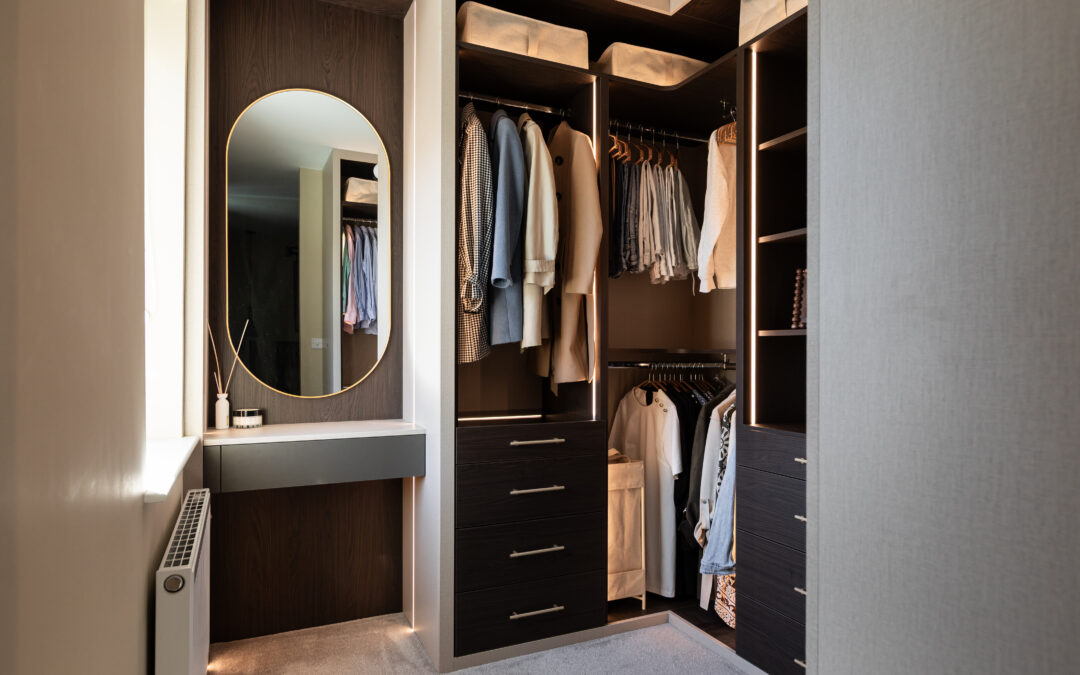
A his and hers wardrobe is a single wardrobe, or a run of wardrobes, designed so that two people each have their own clearly defined storage, laid out around what each person actually owns. The key to getting it right isn’t splitting the space down the middle. It’s working out what each of you needs to hang, fold and store, and designing each side to suit.
Sharing a wardrobe is one of the most common reasons couples come to see us. Usually, one person has gradually taken over most of the rails, or there simply isn’t enough room for two sets of clothes in a standard-sized unit. Whether you’re planning a shared fitted wardrobe in the main bedroom or a full walk-in, this guide covers how to split the space fairly, the layouts that work best, and the measurements worth knowing before your design appointment. The name says “his and hers”, but everything here applies to any two people sharing a wardrobe.
What Is A His And Hers Wardrobe?
A his and hers wardrobe is shared storage divided into two personal zones, each with its own hanging space, drawers and shelving, and often a third shared zone for items you both use. It can be a single fitted wardrobe split down the middle, two separate wardrobe runs in the same bedroom, or a walk-in wardrobe with one side each.
What makes it work is that each zone is designed for the person using it. Someone with many dresses and long coats needs more hanging space for long garments, while someone who wears mainly shirts and folded knitwear gets far more out of double hanging rails and drawers. A wardrobe that gives you both identical interiors usually ends up suiting neither of you.
How To Work Out How Much Space Each Person Needs
Measure The Rail Space You Use Now
The simplest way to plan a fair split is to measure what you already have. Push each person’s hanging clothes together along the rail, as tightly as they’d comfortably hang, and measure how much rail they take up. Do the same for long items, such as dresses, long coats and suit carriers, separately from the short ones. Then add a little extra for growth. Those figures, together with a rough count of folded items and pairs of shoes for each, tell a designer far more than any rule of thumb.
Don’t Default To A 50/50 Split
An even split looks tidy on paper, but most couples own different amounts of clothing, so a 60/40 or even a 70/30 split is often the fairer answer. The person with less hanging space might have more drawers instead, or a dedicated section for sports kit or work uniforms. The goal is for both of you to have enough room, not exactly the same amount of room.
Plan A Shared Zone
Some things don’t belong to either of you: spare bedding, luggage, an ironing board, gift wrap, or the shoes you both kick off at the end of the day. Giving these their own shared section, often at the top of the wardrobe or in the centre of the run, prevents them from spilling into either person’s space. It’s also the part most couples forget to plan for.
His And Hers Wardrobe Layouts That Work
| Layout | How it works | Best for |
| One run, split down the middle | A single floor-to-ceiling wardrobe divided into two zones, with a shared section in the centre or overhead | Most main bedrooms with one long clear wall |
| Two runs, either side of the bed or window | Each person gets their own wardrobe on their own side of the room | Rooms where a bed or window sits in the middle of the main wall |
| L-shaped run | Storage wraps around a corner, with one leg each | Larger bedrooms, or rooms where one wall alone isn’t long enough |
| Walk-in or dressing room | Storage along one or both sides of a dedicated space, with room to dress | Couples with a box room or spare bedroom they can give over to storage |
In most Northern Ireland homes, the shared wardrobe is in the main bedroom, so a single fitted run or two runs either side of the bed are the most common choices. If you have a box room going spare, turning it into a shared walk-in wardrobe frees up the bedroom entirely, and our guide to walk-in wardrobes for small rooms shows how much can be fitted into a compact space.
A Sizing Guide For Shared Wardrobes
These are common planning measurements, worth having in mind before your design appointment. Every room is different, so our designers confirm the exact figures for your space during the check measure.
| What you’re storing | Planning measurement |
| Wardrobe depth for hanging clothes | Around 60cm, so hangers can sit side-on without catching the doors |
| Double hanging (shirts, jackets, folded trousers) | Roughly 90–100cm of clear drop per rail |
| Long hanging (dresses, long coats) | Roughly 1.6–1.8m of clear drop, depending on garment length |
| Shoe shelves | About 22–26cm of height per shelf for most shoes, around double for boots |
| Walk-in with storage on both sides | A room usually at least 1.8m wide, so there’s space to stand and dress between the two sides |
The proportion of long to short hanging matters as much as the total. If neither of you owns many full-length pieces, a short section of long hanging with the rest in double rails will hold far more than a single long rail running the full width.
Choosing The Right Doors For Two People
Door choice affects day-to-day sharing too. With a fitted sliding wardrobe, only part of the wardrobe is open at any one time, as the doors slide over each other. That’s ideal for saving floor space in a busy bedroom. However, it means the door divisions should line up with each person’s zone, so you can both reach your own clothes at once without one of you blocking the other. We plan the interior and the door positions together for exactly this reason.
Hinged doors open the whole wardrobe at once, which suits couples who get ready at the same time, as long as there’s enough clear floor space in front for the doors to swing. Mirrored panels on either type are worth considering too, since they give you both a full-length mirror without taking up wall space elsewhere in the room.
Details That Make Sharing Easier
Lighting For Different Schedules
If one of you is up before the other, integrated lighting earns its place quickly. Soft LED strips that switch on automatically when a door opens mean you can find what you need without turning on the main bedroom light, which matters far more at six in the morning than it does in a showroom.
Soft-Close Doors And Drawers
For the same reason, soft-close drawers and sliding door mechanisms are worth having in a shared bedroom. They stop doors and drawers from slamming shut, which helps when someone is still asleep.
Separate Drawers And Accessory Storage
Drawers are where shared wardrobes most often become messy, because small items have nowhere obvious to go. Giving each person their own drawer stack, with dividers or a lined accessory tray for watches, jewellery, ties and belts, keeps both sides tidy. Our guide to organising your wardrobe properly explains how to plan each zone once it’s built.
Room To Change
Storage needs change over time: a new job with a uniform, a growing shoe collection, or a move towards more folded clothes. Adjustable shelving and rails that can be repositioned let the wardrobe adapt without needing a redesign.
His And Hers Wardrobes In Small Or Awkward Bedrooms
A shared wardrobe doesn’t need a big room, but it does need careful planning. In a smaller bedroom, running the wardrobe floor to ceiling gives you both far more storage from the same footprint, and the space at the very top makes a natural home for the shared zone. Sliding doors help too, because there’s no door swing eating into the space beside the bed.
Sloped ceilings, chimney breasts and alcoves can work in your favour. The lower section under a slope suits drawers or shoe storage for one person, while the taller side takes the long hanging. That’s where wardrobes designed for unusual spaces come into their own, since every section can be shaped around the room rather than the room being forced around a standard unit.
Common Mistakes To Avoid
The most common mistake is splitting the wardrobe evenly without checking what each person owns. Close behind is forgetting the shared items, which then end up squeezed into one person’s side. Couples also tend to underestimate long hanging space, choose door positions that block each other’s zones, or leave lighting off the plan and regret it on the first dark winter morning. Thinking through each of these before your design appointment makes the conversation far more productive.
Planning A Wardrobe For Two?
The easiest way to get a shared wardrobe right is to plan it together, with both of you in the room. Book a free design appointment at our Dungannon or Lisburn studio, bring rough measurements, a few photos, and your rail measurements if you’ve taken them. We’ll design a wardrobe that gives you both the space you need.
FAQs
What is a his and hers wardrobe?
A his-and-hers wardrobe is a shared wardrobe divided into two personal zones, each with its own hanging space, drawers and shelving, usually with a shared section for items like bedding and luggage. It can be a single fitted wardrobe, two separate runs in the same room, or a walk-in with a side each.
How do you split a wardrobe between two people?
Measure how much rail space each person’s hanging clothes currently take up, count folded items and shoes, then design each zone around those figures rather than splitting the space 50/50. Add a shared zone for items you both use so they don’t spill over into either side.
Do his and hers wardrobes need to be the same size?
No. Most couples own different amounts and types of clothing, so an uneven split, such as 60/40, is often fairer. The doors and finishes can still be identical throughout the run, so the wardrobe looks balanced from the outside.
Are sliding wardrobes good for couples?
Yes, as long as the door divisions are planned around each person’s zone. Sliding doors save floor space in a shared bedroom, and when each person’s section is behind its own doors, you can both use the wardrobe at the same time without getting in each other’s way.
Can you fit his and hers wardrobes in a small bedroom?
Yes. A floor-to-ceiling fitted wardrobe with sliding doors makes the most of a small room, with double hanging rails and drawers to maximise capacity and the top section used for shared items.
How do you organise a his and hers closet?
Give each person a clearly defined side, keep everyday items at eye level, use drawer dividers for smaller items, and keep shared things in their own zone. Review it every season and move off-season clothes to higher shelves to stop either side creeping into the other.
What is the 333 rule for wardrobe?
The 333 rule comes from Project 333, a minimalist challenge created by Courtney Carver: dress with 33 items or fewer for three months. The 33 include clothing, outerwear, shoes, accessories and jewellery, but not underwear, sleepwear, loungewear or workout clothes. It’s a useful exercise before combining wardrobes, as it shows how much each person actually wears.
How much does a his and hers fitted wardrobe cost?
The cost depends on the wardrobe’s size, door style, internal layout, finishes and the room’s shape, so we don’t quote a fixed price without seeing the space. Our guide to fitted wardrobe costs in Northern Ireland explains what affects the price, and a design appointment will give you a clear guide price for your room.