
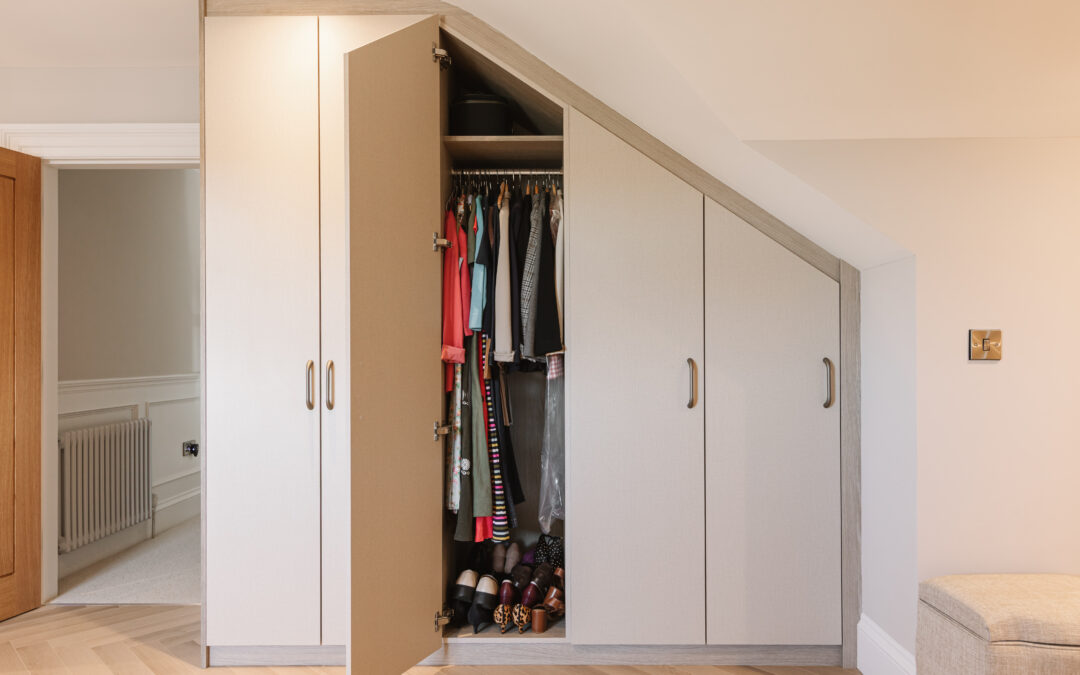
The main difference between fitted furniture and flat-pack comes down to how it’s made and who puts it together. Flat-pack furniture is mass-produced in standard sizes and arrives in boxes for you to assemble at home, while fitted furniture is designed and made to measure for your room, then installed by a professional team so it sits flush against your walls, floor and ceiling.
Both have their place. Flat-pack is quick to buy and easy on the budget, while fitted furniture costs more upfront but is tailored to the space you actually have and made to last. We’ve been designing, making and fitting furniture in Northern Ireland since 1992, and we make freestanding wardrobes as well as fitted ones, so this is a question we talk through with customers in our showrooms all the time.
Below, we explain what separates the two in practice, from the board they’re built from to how they cope with an older house, so you can decide which is right for your home.
What Is Flat-Pack Furniture?
Flat-pack furniture is furniture sold as a kit of pre-cut, pre-drilled panels, packed flat in a box with the fixings and instructions you need to assemble it at home. It’s also called self-assembly or ready-to-assemble furniture, and it’s how most high-street and online wardrobes, chests of drawers and bedside tables are sold.
The format exists to keep costs down. Panels can be cut in volume, stacked tightly for delivery and stored at low cost. Because the buyer assembles them, there’s no fitting cost built into the price. Most flat-pack ranges are made from chipboard or MDF with a foil, melamine or veneer finish. They’re held together with cam-lock and dowel fittings, and the back is often a thin hardboard panel that’s nailed or slotted into place.
That doesn’t make flat-pack poor value. It’s widely available, you can often take it home the same day, and if you move house you can take it apart and bring it with you, with a bit of care.
What Is Fitted Furniture?
Fitted furniture is storage designed for one specific room, made to its exact measurements and fixed in place so it becomes part of the room rather than something standing in it. Instead of choosing a unit and hoping it fits, the furniture is planned around your walls, ceiling height, alcoves and window positions, then made to suit them.
Fitted wardrobes are the most familiar example, but the same approach applies to fitted bedroom furniture, home office storage and built-in living room units. A fitted wardrobe usually runs floor to ceiling and wall to wall, and its interior (hanging rails, drawers, shelving, shoe storage) is planned around what you actually need to store. It’s installed by a professional team, who scribe and adjust it on site so it meets walls and ceilings that are rarely perfectly straight.
Fitted Furniture vs Flat-Pack At A Glance
| Flat-pack furniture | Fitted furniture | |
| How it’s made | Mass-produced in standard sizes | Designed and made to measure for your room |
| Assembly | Self-assembly at home, or a paid assembly service | Installed by a professional fitting team |
| Fit | Set widths and heights, often leaving gaps above and beside | Floor to ceiling and wall to wall, scribed to the room |
| Materials | Often thinner chipboard with a hardboard back | Thicker board throughout (at Enhance, 18mm, including the back panel) |
| Interior layout | Chosen from set modules | Planned around what you store |
| Awkward spaces | Hard to fit around slopes, alcoves and chimney breasts | Built around them |
| Lead time | Often available straight away | Made to order: typically 6–8 weeks with us |
| Moving home | Can be dismantled and taken with you | Stays with the property |
| Upfront cost | Lower | Higher, reflecting design, materials and installation |
| Best for | Short-term homes, tight budgets, occasional use | Long-term homes, awkward rooms, maximum storage |
The Differences You’ll Notice Day To Day
Build Quality And Materials
The type of board a piece of furniture is made from has more to do with how it ages than almost anything else. Flat-pack carcasses are often made from thinner chipboard, and the back is frequently a thin sheet of hardboard pinned into place. That’s fine for light use, but the back is usually the first part to bow or come loose. Unsealed chipboard edges can also swell if exposed to damp, which is worth bearing in mind on a cold external wall or next to an en suite.
Every wardrobe we make, whether fitted or freestanding, is manufactured in our own factory using 18mm board throughout, including a solid 18mm back panel. Thicker board holds screws more securely, flexes less when doors and drawers are used every day, and prevents long shelves from bowing under the weight of folded clothes. You won’t notice the difference in a showroom, but you will after a few years of use.
Fit And Use Of Space
Flat-pack wardrobes come in set widths and heights, so in most rooms they leave unused space: a gap above the wardrobe that gathers dust and boxes, a strip of wall at either side, or an alcove that’s just too narrow for the next size down. Fitted furniture uses that space instead. Because it’s made to your room’s measurements, it can run right up to the ceiling and fill the wall from end to end.
This matters more in Northern Irish homes than people expect. Older houses often have walls that aren’t quite plumb, floors that slope slightly, and ceilings that vary in height across the room. A standard flat-pack unit will sit against those surfaces, leaving visible, uneven gaps. Loft conversions, sloping ceilings and chimney breasts are even harder to work around with standard sizes, which is where wardrobes designed for awkward and unusual spaces come into their own.
Assembly And Installation
With flat-pack, the assembly is up to you. A bedside table might take an hour, while a large wardrobe can take most of a day, and there’s always the risk of a missing fitting or a panel going in the wrong way round. Tall units also need to be fixed to the wall so they can’t tip, a step that’s easy to overlook.
Fitted furniture starts with a measurement check at your home, so every dimension is confirmed before anything is made. Our own fitting team, not subcontractors, then installs it, and most jobs are finished in one to two days.
How Long It Lasts
Flat-pack furniture is designed to be assembled only once. Cam-lock fittings can work loose over time, and taking a wardrobe apart to move house puts the most strain on its joints, which is why flat-pack pieces don’t always survive a second build. Fitted furniture is built to stay where it is. It’s fixed to the room’s structure and made from heavier board. Ours uses heavy-duty sliding door tracks and soft-closing mechanisms, so it’s designed for decades of daily use rather than a few years.
Design Choice
Flat-pack ranges offer a set menu: a handful of finishes, a few standard widths, and interior fittings that slot into fixed positions. With fitted furniture, you choose the door style, finish and handles, and the inside is laid out around your wardrobe. That might mean long hanging for coats and dresses, double rails for shirts, drawers for folded clothes, and a dedicated shoe section. Once it’s in, the interior is usually the part customers value most.
Why Does Fitted Furniture Cost More Than Flat-Pack?
Fitted furniture costs more than flat-pack because you’re paying for design time, made-to-measure manufacturing, heavier materials and professional installation, none of which a flat-pack price includes. The cost of a fitted wardrobe depends on its size, door style, internal layout, finishes, the shape of the room and how involved the installation is. Our guide to what fitted wardrobes cost in Northern Ireland walks through each of these factors.
It’s also worth comparing like with like. Once you add an assembly service, wall fixings, filler panels and a few extra modules to make a flat-pack wardrobe fill an alcove, the gap narrows, and you still end up with standard carcasses rather than furniture designed for the room.
If budget is the deciding factor, there’s a middle ground. Our Eco Range offers a made-to-measure, floor-to-ceiling sliding wardrobe, designed, made and fitted by our own team, with a curated selection of finishes and pre-designed layouts that keep the cost down. Enhance Sliding Wardrobes also offers low-cost finance options across its range, including 0% finance over 12 months.
Can You Make Flat-Pack Furniture Look Fitted?
You can make flat-pack wardrobes look closer to fitted ones, and it’s a popular approach. The usual method is to line up several standard units, then add filler panels at the sides, a plinth at the bottom and a cornice or bulkhead at the top to close the gaps. Done carefully, it gives a neater, built-in look.
It’s worth knowing what you do and don’t get, though. Filler panels hide gaps rather than use them, so the space above and beside the units is still lost for storage. The carcasses remain standard flat-pack construction, and the interior is still limited to set modules. Scribing panels to uneven walls also requires real joinery skill, and if you’re paying someone to do it, the labour adds up quickly. For a long-term home, it can end up costing closer to properly fitted furniture than you’d expect.
When Flat-Pack Makes Sense
Flat-pack is a sensible choice when the furniture doesn’t need to last long or withstand heavy use. It suits a short-term rental where you can’t fix anything to the walls, a spare room used only occasionally, or a nursery you expect to change in a few years. It also makes sense when the budget means you need something now rather than something perfect.
If you need furniture you can take with you but don’t want flat-pack quality, a professionally made freestanding wardrobe sits between the two. Our freestanding wardrobes aren’t flat-pack. They’re built in our own factory from the same 18mm board as our fitted ranges, delivered and installed by our team, and made in set widths, typically taking around four weeks from order. For a fuller comparison of those two routes, see our guide to fitted vs freestanding wardrobes.
When Fitted Furniture Is The Better Choice
Fitted furniture makes the most sense when you’re staying put and want the room to work well for years. It’s usually the better choice if:
- you own your home and plan to stay for the long term
- the room has sloped ceilings, alcoves, a chimney breast or uneven walls
- you need as much storage as possible from a small or narrow room
- you want a seamless, built-in finish with no gaps to dust
- you’d rather have the interior designed around your clothes than pick from set modules
Built-in storage is also something buyers tend to notice when you come to sell, although how much it affects value depends on the property and the quality of the work.
Ready To See The Difference For Yourself?
If you’re weighing up flat-pack against fitted furniture, the easiest way to compare is to see and feel the difference in person. Book a free design appointment at our Dungannon or Lisburn studio, bring rough measurements and a few photos of the room, and we’ll talk you through what would work for your space and budget, whether that’s fitted, freestanding or our Eco Range.
FAQs
What is the difference between fitted and flat-pack furniture?
Flat-pack furniture is manufactured in standard sizes and sold as a kit for you to assemble at home. Fitted furniture is designed and made to measure for a specific room and installed by professionals, so it fills the space from floor to ceiling and wall to wall.
What are the downsides of flat-pack furniture?
Flat-pack furniture comes in fixed sizes, so it often leaves gaps around the unit, and it’s usually made from thinner board with a lightweight back panel. Assembly takes time, the fittings can loosen, and it doesn’t always survive being taken apart and rebuilt after a house move.
What are the downsides of fitted wardrobes?
Fitted wardrobes cost more upfront, take longer to arrive because they’re made to order, and stay with the house if you move. In a long-term home, the extra storage and better finish often outweigh these drawbacks, but they’re worth weighing if you’re likely to move soon.
Why are fitted wardrobes more expensive than flat-pack?
Fitted wardrobes are more expensive because the price includes design, made-to-measure manufacturing, heavier materials and professional installation. Flat-pack keeps costs low by using standard sizes and leaving assembly to the buyer.
Do fitted wardrobes add value to a house?
Fitted wardrobes can make a home more appealing to buyers, as good built-in storage stands out during viewings. The effect on price varies from one property to the next, so it’s best seen as a benefit while you live there, with added appeal when you sell, rather than a guaranteed return on investment.
Can I take fitted furniture with me when I move?
Generally, no. Fitted furniture is made for and fixed in a specific room, so it stays with the property. If you’re likely to move in the next few years, a professionally made freestanding wardrobe offers better quality than flat-pack and still moves with you.
Are fitted wardrobes outdated?
No. Fitted wardrobes have moved a long way from the heavy, dark designs many people remember. Modern fitted wardrobes use clean-lined sliding doors, matt and wood-effect finishes, mirrored panels and integrated lighting. They remain one of the most practical ways to add storage to a bedroom.
How long does it take to get fitted furniture installed?
Fitted furniture is made to order, so with us lead times are typically around six to eight weeks from the order date. Most installations are completed within one to two days by our own fitting team.